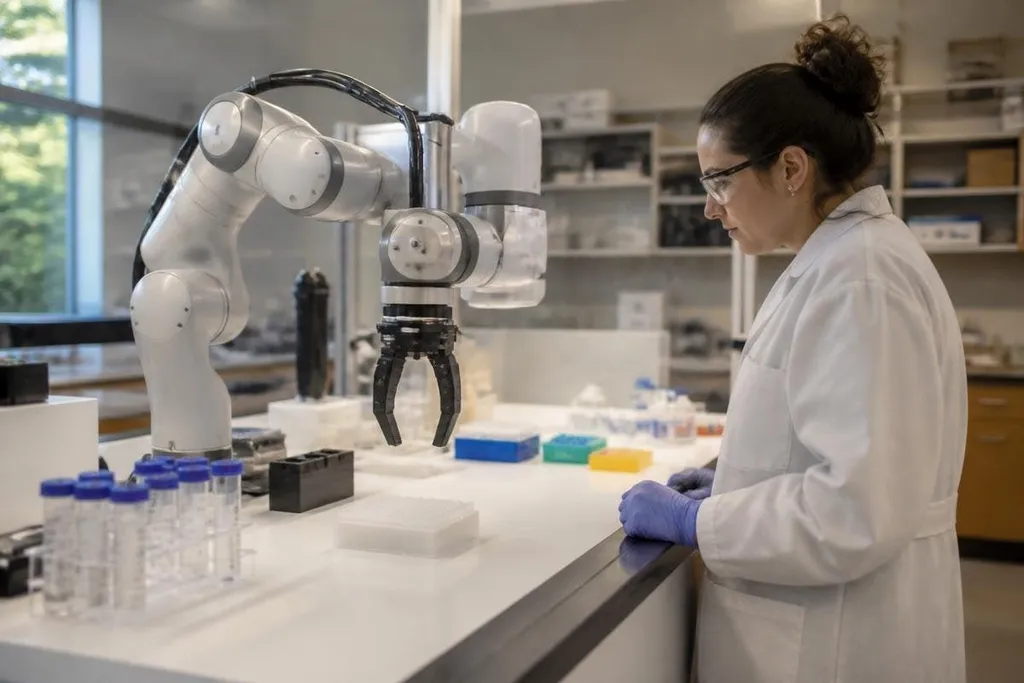
A research robot can now use camera images, force readings, and written instructions to choose its next action. That changes lab automation from a fixed sequence of moves into a system that can respond to new objects and conditions.
- AI links sight, touch, and movement in one control loop.
- A research robot can adjust a task when a sample shifts or a tool is missing.
- Human checks still matter for safety, repeatable results, and unusual failures.
From fixed steps to task plans
Traditional lab automation follows a script. The robot moves to a known point, closes a gripper, places an item, and repeats the same sequence. That works when the table, object, and tool stay in the same place.
AI changes the planning step. A model can read a task such as “pick up the tube and place it in the rack,” then break that request into movement, gripping, checking, and placement.
A motion controller still needs to turn each step into safe joint movement, but the plan can change when the scene changes. That matters in research labs because samples rarely arrive in perfect positions.
A camera may find a tube at a new angle. A force sensor may show that the gripper touched the rack early. The control system can pause, update its plan, and try a safer movement.
Cameras become part of the control loop
Computer vision gives the robot information about shape, color, position, and movement. LiDAR can add depth by measuring distance with light, while a wrist-mounted force sensor can show whether the gripper has touched an object.
The useful change comes from linking those signals. A camera can locate a sample, but it can't confirm a secure grip on its own. Force data can fill that gap. The robot can close the gripper until the sensor reports contact, then lift slowly and check whether the sample moved with it.
This approach also helps when objects differ slightly. A system trained to identify one type of container may detect its position even when the label faces away or the container sits a few centimeters from its expected spot. That does not remove the need for careful training data. It gives the robot more information before it moves.
The training data behind those choices is worth tracking as systems learn from mistakes. Research robotics coverage from Robot24.com can connect a software update to the lab task, test date, and human review. Failed attempts show whether the change helped outside a clean run.
Learning from failed attempts
AI can learn patterns from recorded robot actions, simulation runs, and human demonstrations. A model may see that a light grip causes a sample to slip, while a slower approach keeps the object stable. The robot can then rank those actions when it meets a similar task.
The quality of that learning depends on the records. A lab needs clear sensor data, known task results, and enough examples of failure. If the training set contains only clean demonstrations, the system may perform well beside the test bench and fail when a cable crosses the work area.
Simulation can produce more practice without risking equipment. The gap between a simulated arm and a physical arm still matters. Surface friction, motor wear, lighting, and small calibration errors can change the result. A model that works in simulation needs checks on the real robot before anyone relies on it for a research process.
Where AI still needs supervision
Research work depends on repeatable results. A robot that finds a new route each time may finish the task, but that route can make an experiment harder to compare with earlier runs.
AI can also misread a scene, choose an unsafe grip, or act on an unclear instruction. The lab needs limits around speed, force, workspace, and tool access. A person should be able to stop the robot and inspect the state that led to a bad choice.
The open issue is proof. A convincing demonstration shows that a robot completed one task under one set of conditions. It does not show how often the system fails across different samples, lighting, tools, and operators. Those records matter more than a short video when the robot supports published research.
Before you buy or build
Use this checklist to judge an AI system for lab work:
- Name the task: Write the exact action, object, and acceptable result.
- Check the sensors: Confirm that cameras, depth sensors, or force sensors can see the failure cases that matter.
- Record repeatability: Compare success rate, timing, and placement error across repeated runs.
- Set hard limits: Restrict speed, force, joint range, and access to samples or tools.
- Plan human checks: Decide when a person must approve a plan, inspect a sample, or stop the robot.
I'd skip any system that shows a polished demo but gives no failure records or test conditions.
The next useful measure is not how many tasks a robot can claim to handle. It is how often the same task succeeds after the sample, tool, lighting, and operator change.